 Fomo family
Fomo family portfolio tracking helps you assess position size before changing exposure
Fomo family brings portfolio and profit-and-loss tracking together, giving you context for sizing a planned buy or sell against your existing holdings. Compare the proposed position with the same portfolio total, review the transaction costs before confirmation, and judge the completed adjustment by actual token quantities.
Updated onBottom line: Position weight depends on current holdings and portfolio value; profit figures alone do not show how much exposure another trade would add.
Read the existing holding before sizing another order
A useful starting balance includes the selected token's quantity, its estimated value, and the portfolio total that you intend to measure against. Express the holding's estimated value and the portfolio total in the same currency and use observations taken close together. Mixing an earlier position value with a newer portfolio total distorts the comparison.
The proposed trade amount describes an addition or reduction. It does not describe the entire position after execution. An existing holding remains part of your exposure when you buy more. For a sale, the relevant endpoint is the quantity that would remain, alongside the proceeds after costs.
Fomo provides portfolio, PnL, and transaction-history views. These serve different purposes: holdings describe what remains, while history records the transactions behind changes. A completed adjustment should leave quantities that agree with the executed trade. A change in the portfolio's displayed currency value alone cannot establish that agreement.
How much would the planned order change your portfolio weight?
The change in percentage points is the resulting portfolio weight minus the starting weight. Calculate each weight as position value divided by portfolio value, multiplied by 100, using a common currency and valuation time for each pair.
For an ordinary spot holding, quantity multiplied by unit price gives its estimated market value. Dividing that value by the chosen portfolio total gives its portfolio weight. Multiply the fraction by 100 to express it as a percentage. This calculation describes concentration, without assigning a suitable allocation to the token.
Keep the portfolio total consistent
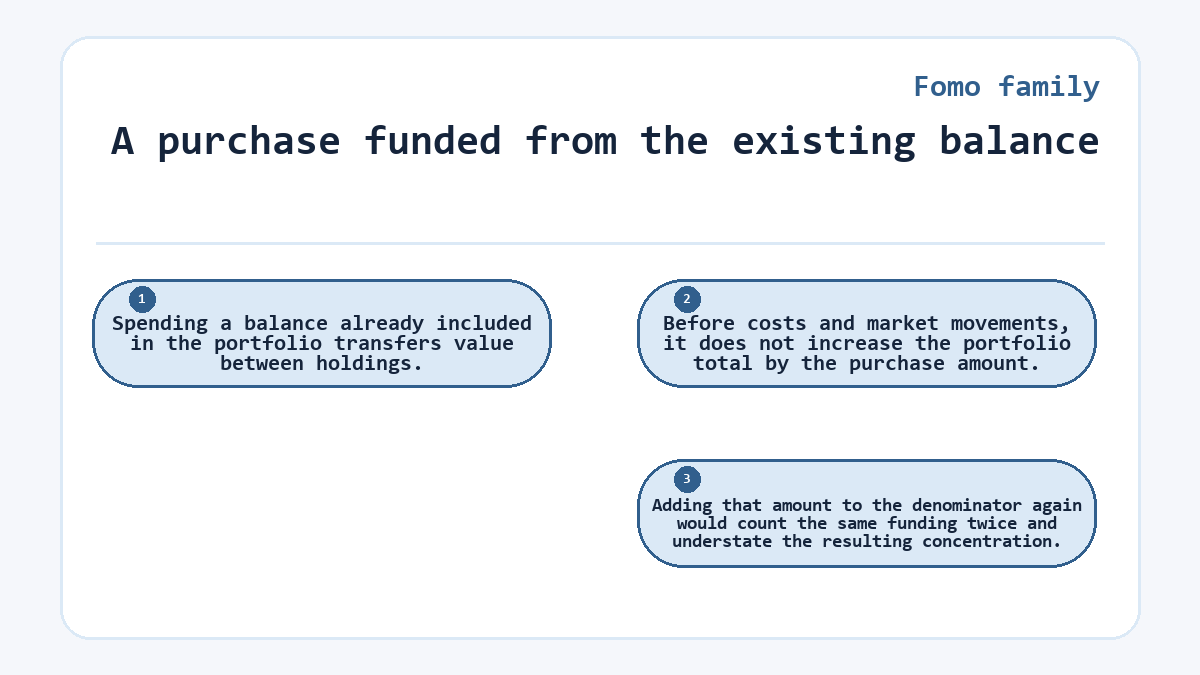
A purchase funded from the existing balance
Spending a balance already included in the portfolio transfers value between holdings. Before costs and market movements, it does not increase the portfolio total by the purchase amount. Adding that amount to the denominator again would count the same funding twice and understate the resulting concentration.
A purchase funded by a new deposit
New funds increase the total when they enter the portfolio being measured. Include them once, whether they remain unspent or fund the purchase. Keep a pending deposit separate from funds already available when estimating what the proposed transaction can use.
When recalculating portfolio weight after a new deposit, keep derivative exposure distinct from equity. Fomo's perpetual-position information distinguishes notional position size from equity. Notional describes the exposure; equity describes the position's account value. Adding leveraged notional to a spot portfolio total as though it were owned capital produces a misleading denominator.
Keep the proposed amount editable until confirmation
If reversibility matters, finish the sizing calculation before authorizing the transaction. Fomo advertises one-click trading, so do not assume an additional review screen will follow every action. Identify the control that commits the order before using it.
A draft amount remains a proposal only while no execution instruction has been submitted.
Fomo displays its applicable transaction fee before confirmation. Account for that charge when estimating the resulting position and remaining spending balance. Other execution costs and price differences can affect the final outcome, so a quote remains an estimate of the adjustment.
An amount that exceeds your chosen allocation can be reduced before submission. Recalculate using the revised proposal, including its costs. Once execution has occurred, an opposite trade introduces another transaction with its own price and charges. It does not restore the original transaction's terms.
Compare adjustments by the exposure they leave behind
Holding, adding, reducing, closing, and reallocating produce different remaining positions. The comparison below concerns spot holdings. None of these choices establishes a security rating for a token or makes its liquidity sufficient for the intended sale.
| Choice | Effect on the selected holding | Remaining constraint |
|---|---|---|
| Leave the holding unchanged | No trade changes its token quantity | Market movements still change its value and weight |
| Add to the holding | A completed purchase increases token quantity | More capital remains exposed to that token |
| Sell part of the holding | A completed sale reduces token quantity | The unsold quantity retains its market exposure |
| Sell the entire holding | Selling every unit removes that spot holding | Proceeds remain exposed to the asset received |
| Reallocate into another holding | Capital moves out of one holding and into another | The replacement may share the same market risks |
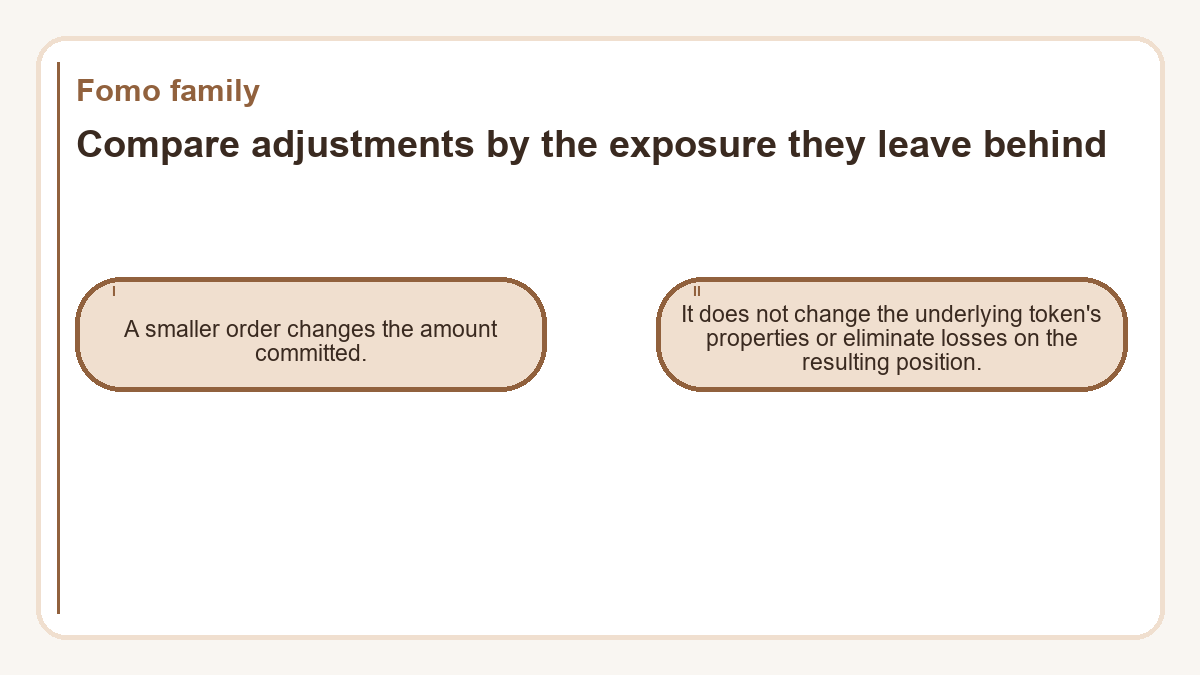
A smaller order changes the amount committed. It does not change the underlying token's properties or eliminate losses on the resulting position.
Does positive PnL justify increasing a position?
Positive PnL does not establish that increasing a position fits your allocation. Profit and loss measures performance against a calculation basis; position weight measures concentration within a portfolio. A profitable holding may already occupy more of that portfolio because its price rose. Buying more adds exposure at the new execution price, even when the earlier purchase remains profitable. Read the gain and the proposed remaining position as separate quantities.
Separate price drift from unexplained quantity changes
When quantity stays constant, a price move can change both a holding's displayed value and its share of the portfolio. Movements elsewhere also matter. A token can become a larger percentage of the total because other holdings fell, even if its own price did not rise.
A spot holding's estimated market value equals its token quantity multiplied by the valuation price. This relationship helps distinguish a valuation change from an actual change in holdings. It does not establish the proceeds available from selling the whole position, because execution prices can differ from the displayed valuation.
An unexplained quantity difference makes the sizing baseline unreliable. Compare the holding with recorded purchases, sales, and transfers before proposing another adjustment. If the difference remains unresolved, keep the additional order unsubmitted. That preserves the ability to revise its size without creating another balance change to untangle.
A refreshed profit figure cannot reconcile missing units.
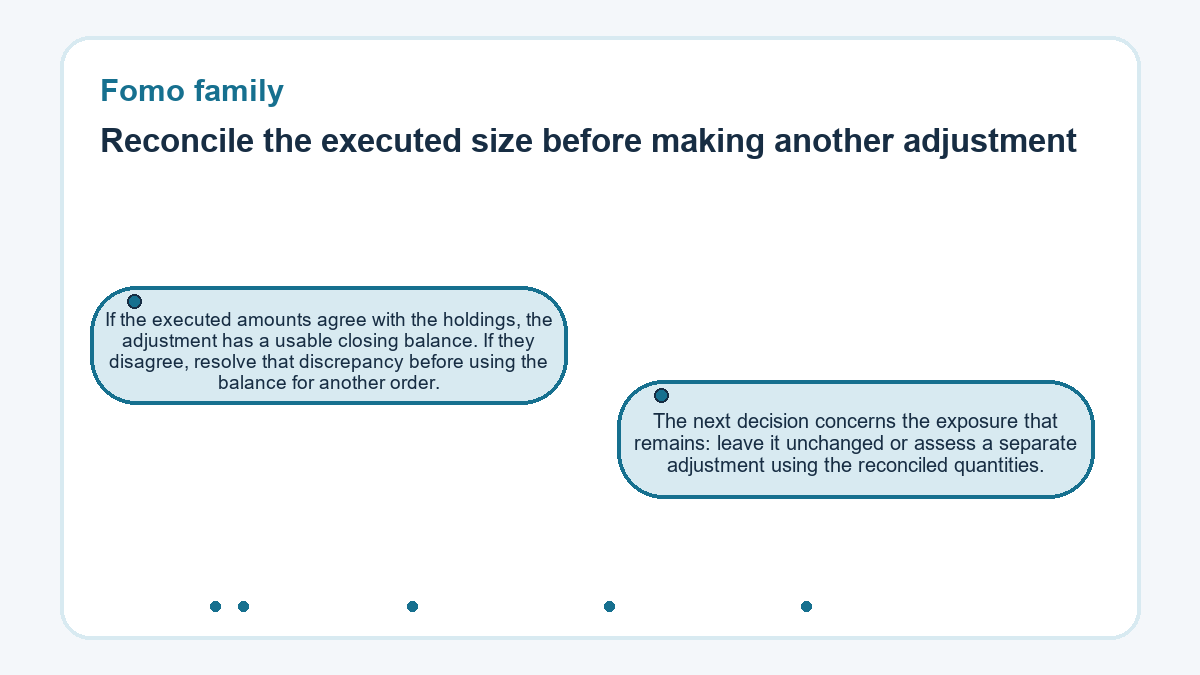
Reconcile the executed size before making another adjustment
The completed trade supplies the quantities for the final allocation calculation. Estimated output belongs to planning; actual tokens received or sold belong to reconciliation. For a purchase, account for the added units and the funding spent. For a sale, account for the units removed and the proceeds received.
Compare the remaining position and portfolio total at a common valuation time. Market movement during execution may leave a different portfolio weight from the proposed calculation, even when the trade executed correctly. Fees also change the capital remaining within the measured portfolio.
If the executed amounts agree with the holdings, the adjustment has a usable closing balance. If they disagree, resolve that discrepancy before using the balance for another order. The next decision concerns the exposure that remains: leave it unchanged or assess a separate adjustment using the reconciled quantities.
Helpful answers about Fomo family
Should unspent trading funds count in my portfolio allocation?
Include unspent funds when they belong to the portfolio that your allocation measures. Excluding them answers a narrower question: how your invested holdings divide among themselves. Both calculations can be useful, but changing between them makes the same position appear to change weight without a trade. Keep the denominator consistent across comparisons.
What does a percentage-based sell amount refer to?
A percentage-based sell amount needs a defined base, such as the selected token quantity. It does not automatically mean the same percentage of your whole portfolio. Before confirmation, inspect the actual quantity proposed for sale and the quantity that would remain. Do not infer the control's meaning solely from the displayed percentage.
Are several small token positions necessarily diversified?
Several small positions can share substantial exposure to the same market conditions. Different token names do not establish independent price behavior. Position weight measures each holding separately, while diversification also concerns relationships between holdings. Splitting capital among tokens that respond similarly to market changes may leave much of the original concentration.
Which purchase price matters after several buys of the same token?
Current position size depends on the total quantity held and its valuation price. Earlier purchase prices matter for acquisition cost and PnL. For multiple purchases, a quantity-weighted acquisition price reflects the amounts bought at each price. Keep fees consistent with the chosen cost calculation, and do not assume every performance display uses the same treatment.
Does selling part of a holding erase its earlier losses?
A partial sale does not erase the holding's earlier losses. It reduces the quantity still exposed and realizes a gain or loss on the sold portion under the relevant cost calculation. The remaining position continues to change in value. A revised average or percentage display does not reverse the economic effect of earlier transactions.
How should transferred tokens affect a position-size check?
Transferred tokens count toward exposure when they form part of the holdings being measured. Their market value exists even if the receiving account lacks their acquisition history. Missing purchase records can complicate PnL interpretation without making the tokens valueless. Measure current exposure separately from the historical cost needed to explain performance.
When does a saved buy amount need another allocation check?
A saved amount needs reassessment whenever holdings, portfolio value, available funding, or relevant transaction costs have changed. The same spending amount can represent a different portfolio share later. Treat a preset as an amount-entry convenience rather than a maintained allocation target, unless the specific control explicitly provides that separate function.
Is a chosen position-weight limit a maximum possible loss?
A position-weight limit describes allocation, not a guaranteed loss ceiling. For an unleveraged spot purchase, the capital committed can lose its value, while execution costs affect the total outlay. The portfolio percentage also moves with prices. A limit used during planning does not automatically sell holdings or maintain their weight afterward.